
"Digital twin" is one of engineering's most overworked phrases. Depending on who is pitching, it can mean a real-time control loop wired to physical sensors, or a glossy 3D render with a dashboard glued to the side. For the opening WPE Cake Meeting of 2026–2027, we put four researchers in a room with cake and five minutes each to test what the phrase holds up against: motorcycles in Bali, sewage sludge from Bradford, rainwater hitting rooted soil, and air moving across an occupied room.
What made the hour worth leaving your desk for was not polished slides. It was the places where models broke, where data went missing, and where someone from a completely different corner of the School recognised an equation they use every week.
1. Motorcycles in Bali, 48-hour police lags, and a 100 Hz smartphone
First-year doctoral researcher I Wayan Arnaya opened with a problem most of WPE does not normally see on a whiteboard: urban road crashes. Globally, road traffic injuries claim around a million lives a year and are the leading cause of death among people aged 5 to 20, costing national economies 1 to 3% of GDP. Wayan works with Indonesia's Ministry of Transportation and is building a proactive digital twin for road safety, supervised by Dr Amirul Khan, Prof. Paul Eke, Dr Arash Rabbani, and Prof. Oliver Carsten.
His sharpest point was why standard machine learning fails here. Crash prediction runs straight into three walls: the rarity problem (fatal crashes happen too infrequently at any single junction to train a reliable observational model), the completeness problem (Indonesia's Road Safety Management System loses 40 to 60% of critical fields such as vehicle condition and exact severity), and the temporal lag problem (by the time a police report is geocoded 48 hours later, the rain, traffic, and road state that caused the crash have vanished).
Because low- and middle-income cities rarely have dense roadside sensor grids, Wayan's five-layer architecture is built around what people already carry: 100 Hz smartphone inertial sensors from volunteer pilot riders, paired with OpenStreetMap geometry, weather APIs, and traffic cameras, feeding a hybrid XGBoost and Dynamic Bayesian Network over 4G/5G to run real-time "what-if" risk analysis.
The questions came immediately from across the group. Dr Douglas Booker (Indoor Air) asked where the proposed rider and authority interventions originated (Wayan's own Ministry experience). Joining online, Dr Claire Grisaffi (Sanitation and WASH) pressed on low-income data constraints and how to access phone telemetry ethically, prompting a discussion on opt-in pilot cohorts of 15 to 100 riders rather than mass data harvesting. Prof. Paul Eke (Royal Academy of Engineering Visiting Professor) probed the transfer gap between UK testbed data from London and Bali's motorcycle-dominated streets, while Dr Marco-Felipe King spotted Bayesian calibration as a direct bridge to his own microbial exposure modelling.
2. Teaching a process simulator what Bradford sewage sludge is
If digital twins sound effortless in grant applications, second-year PhD researcher Khadija Al Balushi (supervised by Dr Amirul Khan, Prof. Miller Alonso Camargo-Valero, Prof. Paul Eke, and Dr Arash Rabbani) gave the room a healthy dose of reality. Wastewater treatment plants already use anaerobic digestion (AD) to turn sewage sludge into methane-rich biogas, but conventional AD is carbon intensive and does not recover hydrogen separately. Khadija is asking whether retrofitting an upstream dark fermentation (DF) stage can harvest biohydrogen first while preserving downstream methane yield, and whether the retrofit pays off once energy, cost (techno-economic assessment), and environmental impact (life-cycle assessment) are counted.
She began in Aspen Plus using thesis data from an earlier Leeds doctoral study. Almost immediately, she hit two walls. First, a process simulator has no built-in button for "sewage sludge": she had to define its chemical composition and molar weight from scratch using the Buswell equation, volatile fatty acid pathways, and Monod kinetics. Second, published studies tested dark fermentation and anaerobic digestion separately, not as a coupled retrofit, and sludge characteristics vary sharply from plant to plant.
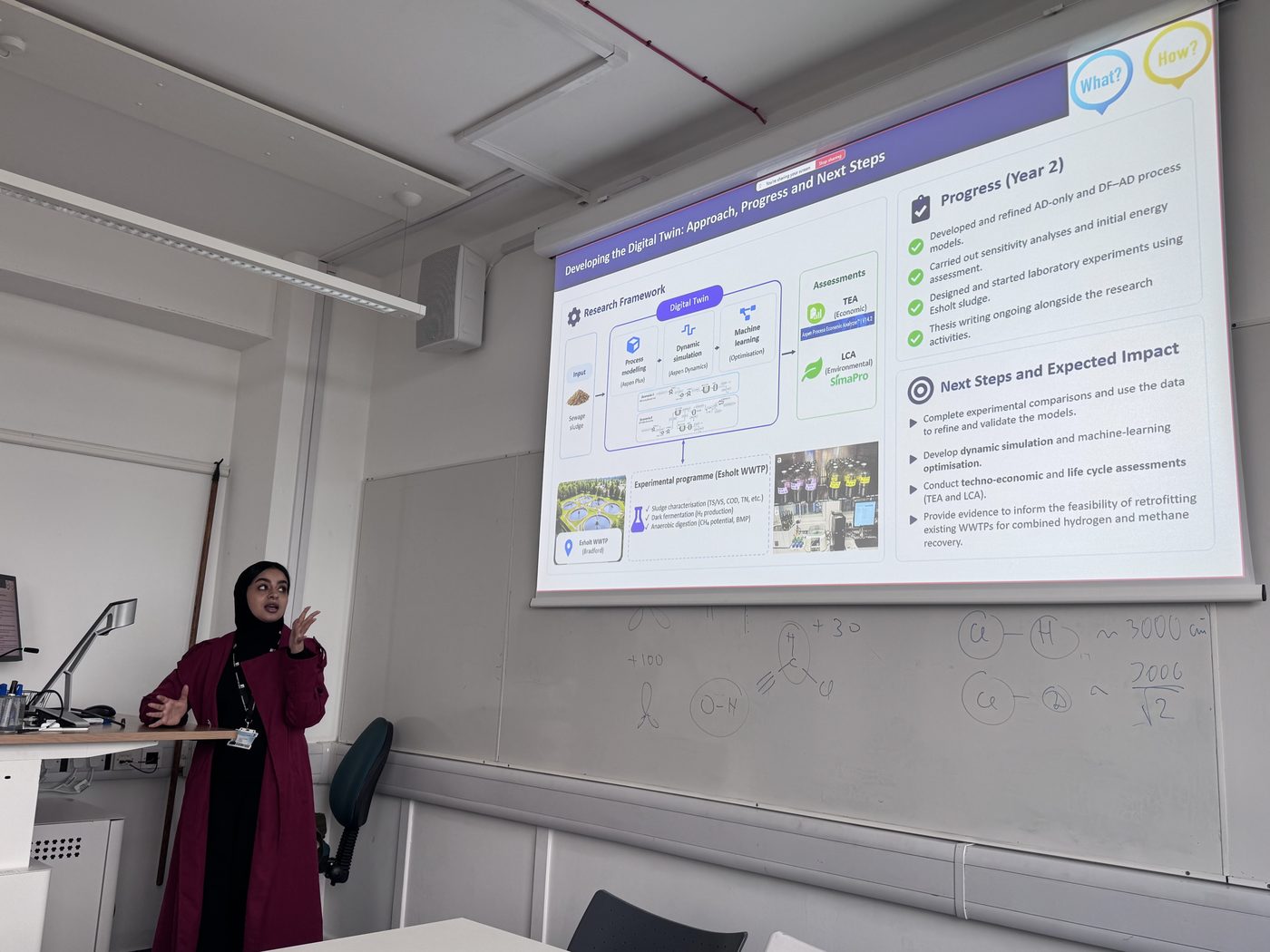
Khadija Al Balushi presenting her coupled dark-fermentation and anaerobic digestion framework, linking Aspen Plus and Aspen Dynamics modelling to bench-scale experiments using sludge from Esholt Wastewater Treatment Works in Bradford.
Rather than trust an unvalidated simulation, Khadija added an experimental programme after her transfer, collecting hydrolysed sludge and digestate from Esholt Wastewater Treatment Works in Bradford to run bench-scale dark fermentation bottles and automated methane-potential tests. Next, she will feed the dark-fermentation intermediates into anaerobic digestion, move her models from steady state to Aspen Dynamics, and bring in machine learning to search for optimal operating conditions without having to live in the laboratory forever.
"I will be really happy if my model predicts the same thing I've done in the lab. That is the first step, and then we'll see."
Khadija Al Balushi, answering Dr Claire Grisaffi on how far she would push her model's predictionsWhen someone in the room noted that her five-minute talk made it look smooth and asked where it had actually been hard, Khadija did not sugar-coat it: every stage brought a bottleneck, from chemistry to kinetics to moving into dynamic simulation. That kind of candour is exactly what an internal group seminar is for.
3. When the rain outpaces the soil
Second-year PhD researcher Jiaxian Li (supervised by Dr Xiaohui Chen and Dr Amirul Khan) shifted the lens underground. When heavy rain falls on vegetated soil, infiltration is governed by the Richards equation with a sink term for root water uptake. The mathematical headache sits right at the ground surface: before saturation, rainfall rate controls how fast water enters the soil; the moment the surface saturates and ponding begins, the boundary condition abruptly switches to a prescribed pressure head. Worse, the timing of that switch depends on the solution itself and on how plant roots are distributed with depth.
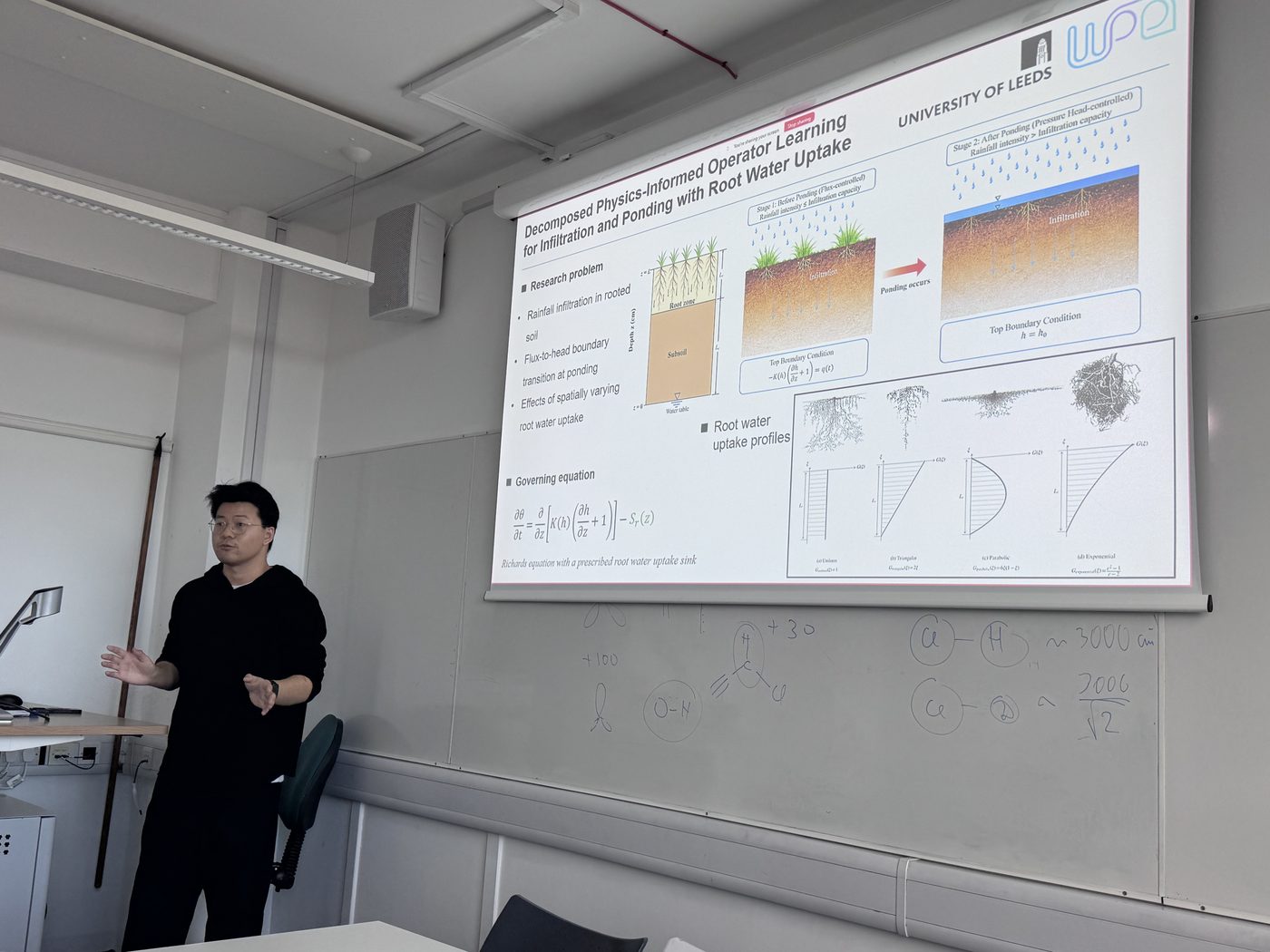
Jiaxian Li walking the group through the Richards equation, the flux-to-head surface boundary transition at ponding, and the four root water uptake profiles used to train and test his decomposed operator framework.
To predict soil-water evolution rapidly across many root architectures without rerunning slow numerical solvers every time, Jiaxian developed a decomposed physics-informed deep operator network (PI-DeepONet) on the University's high-performance computing cluster. Instead of forcing one neural network to absorb the sharp jump at ponding, he splits the physics into two parts: an auxiliary field (background infiltration without roots plus a root-uptake source response) and a causal boundary correction that switches on after ponding.
Tested on 400 held-out root uptake profiles across three soil types (silt loam, silty sand, and silt), the framework predicted ponding time to within a mean absolute error of 0.06 to 0.37 minutes, with water-content root-mean-square error of 2.2 to 3.6 × 10⁻⁵ cm3/cm3. Asked who would use this outside a numerical-methods paper, Jiaxian pointed straight to slope stability and landslide mitigation: testing which tree and grass root distributions delay surface ponding and runoff before a slope fails.
4. Compressing a room into modes, and knowing when AI breaks
Closing the talks, WPE Deputy Director Dr Amirul Khan presented ongoing work led by doctoral researcher Osama on machine-learning surrogates for indoor airflow, thermal comfort, and airborne infection risk in hospitals, classrooms, and offices. Computational fluid dynamics (CFD) has long underpinned WPE's building-ventilation design, but full CFD is too slow for interactive multi-objective optimisation or real-time building control, taking hours per case when designers need hundreds of scenarios.
Rather than asking a neural network to learn millions of mesh cells from scratch, the team compresses CFD snapshots using Proper Orthogonal Decomposition (POD) via Singular Value Decomposition, extracting the few dominant energetic flow modes that describe how air moves around furniture, inlets, and outlets. A surrogate then maps pixel-encoded room layouts straight to those modes in seconds rather than hours.
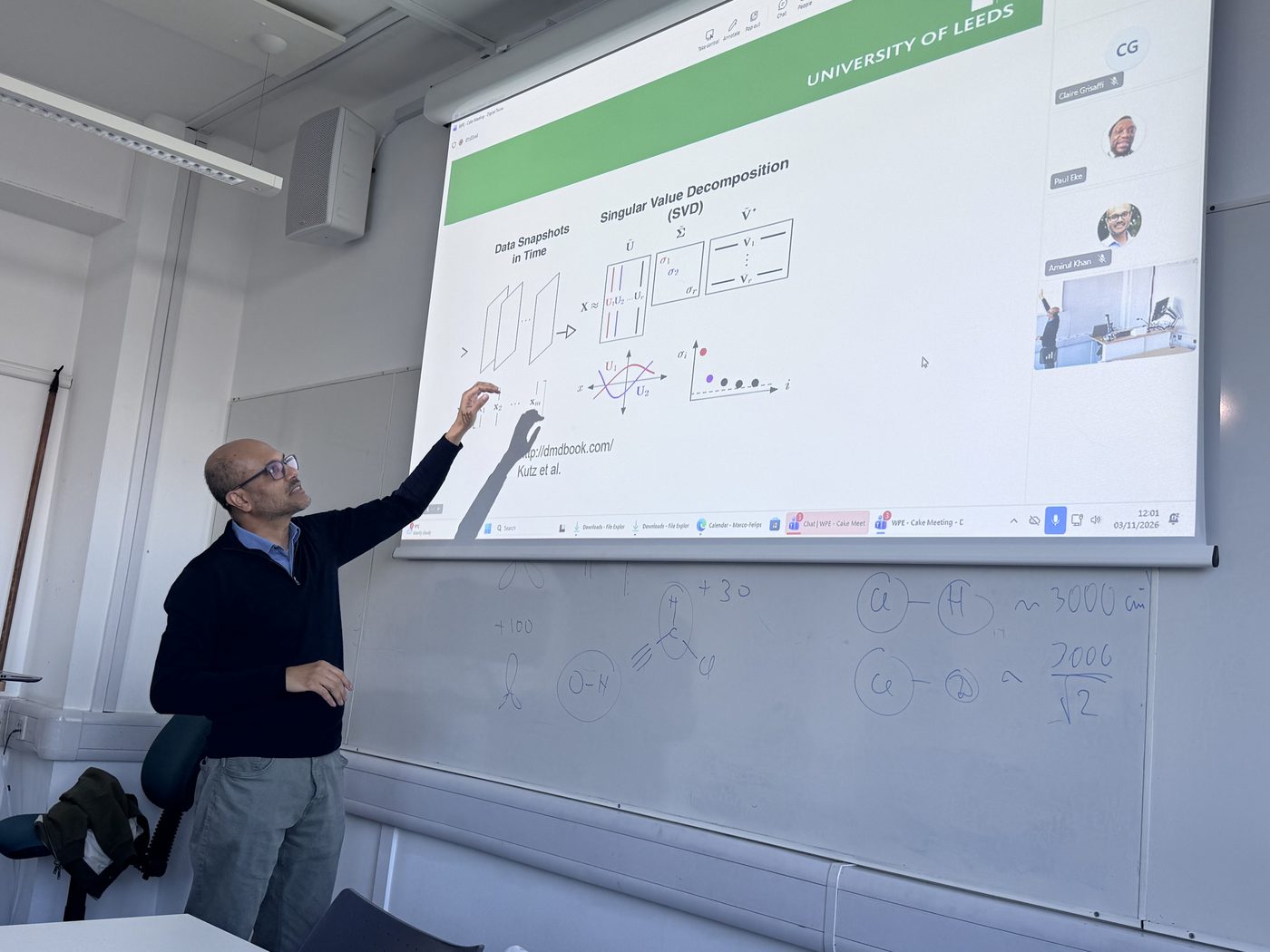
Dr Amirul Khan explaining how Singular Value Decomposition extracts dominant indoor-airflow modes, with Dr Claire Grisaffi and Prof. Paul Eke joining the discussion live on Microsoft Teams.
Equally valuable was Amirul's scepticism. Early hype around operator learning led some to claim CFD would soon be obsolete, yet in practice surrogates still struggle to generalise when room geometries deform across unseen boundaries (Gaussian Process Regression, for instance, broke down quickly on unfamiliar obstacle shifts). And no static model knows when someone opens a window or when sixty students walk into a lecture room. That is where WPE's wider strength comes in: pairing fast reduced-order models with live environmental sensors via data assimilation, testing assumptions in the downstairs Class II aerobiology chamber, and checking predicted infection risk with our microbiologists.
The thread across the room
In the closing ten minutes, something telling happened. None of the people around the table worked across all four domains: transport safety, wastewater biohydrogen, unsaturated soil mechanics, and indoor fluid dynamics. Yet everyone recognised the same underlying grammar: Bayesian calibration, governing PDEs, surrogate compression, sparse field data, and the discipline of checking a clean digital model against an untidy physical world.
That is a quiet statement of what WPE stands for. Whether the system is a hospital ward, a Bradford digester, a vegetated slope, or a junction in Bali, our engineering starts with physics, insists on empirical verification, and asks who will actually act on the output. It is also why interdisciplinary problems can no longer be solved in one office: the airflow modeller needs the sensor specialist, who needs the microbiologist, who needs the people working in low-resource settings.
Come for the cake, own a session in 2027
WPE Cake Meetings run monthly on Tuesdays (12:00 to 13:00, hybrid), and the format is deliberately open. Not every month needs to be four research talks: past and planned formats include fellowship and grant-writing clinics, technical skills and solver workshops, career-trajectory conversations, shut-up-and-write sessions, and non-work cultural "Rainbow" gatherings.
- Open 2027 monthly slots: 19 January (Funders, REF and the spring calls), 2 February (Social science and water), 2 March (LCA and circular economy), plus open dates in April, May (around WPE All-Hands in Leeds Week, 10–14 May 2027), and June.
- How to get involved: Claim a date as an academic host or PGR/PDRA co-host, swap in your own topic, or suggest an idea even if you cannot host. One house rule from the sign-up sheet: find someone other than the host to bring the cake.
See the full programme on our Cake Meetings page or email Dr Marco-Felipe King to claim a 2027 slot.
Session Record
- Series
- WPE Monthly Cake Meetings (2026–2027 Series, Session 1)
- Date & Format
- Tuesday 3 November 2026 · Hybrid (School of Civil Engineering & Microsoft Teams) · Five-minute provocations and open discussion
- Session Chairs
- Dr Marco-Felipe King (Director of WPE) & Dr Amirul Khan (Deputy Director of WPE)
- Speakers & Talks
-
- I Wayan Arnaya (Year 1 PGR): Prediction and Prevention of Urban Road Crashes: A Design of Proactive Digital Twin for Transport Safety
- Khadija Al Balushi (Year 2 PGR): Digital Twin Framework for Biohydrogen and Biomethane Recovery from Sewage Sludge
- Jiaxian Li (Year 2 PGR): Decomposed Physics-Informed Operator Learning for Infiltration and Ponding with Root Water Uptake
- Dr Amirul Khan (presenting collaborative work with doctoral researcher Osama): Reduced-Order Modelling and Machine Learning Surrogates for Indoor Airflow
- Cross-Theme Discussants
- Dr Douglas Booker (Indoor Air), Dr Claire Grisaffi (Sanitation & WASH, online), Prof. Paul Eke (RAEng Visiting Professor in Digital Twin Technology & Systems Engineering, online)
- WPE Themes Linked
- Data-Driven & Computational Methods, BioResources & Circular Economy, Indoor Air Quality & Airborne Infection, Water & Geotechnics, Sanitation & WASH (LMIC data constraints)
- External Partners Mentioned
- Esholt Wastewater Treatment Works (Bradford), Indonesia Ministry of Transportation, Institute for Transport Studies (University of Leeds)
2026–2027 Cake Meetings schedule · Data-driven and computational methods · BioResources and Circular Economy · Indoor Air Quality · Meet our people