

From airflow in a hospital ward to contaminant transport through rock, we develop computational methods that combine physical understanding with experimental, field and sensor data. The result is models that are fast enough to inform decisions, physically meaningful enough to be trusted, and explicit about what remains uncertain.

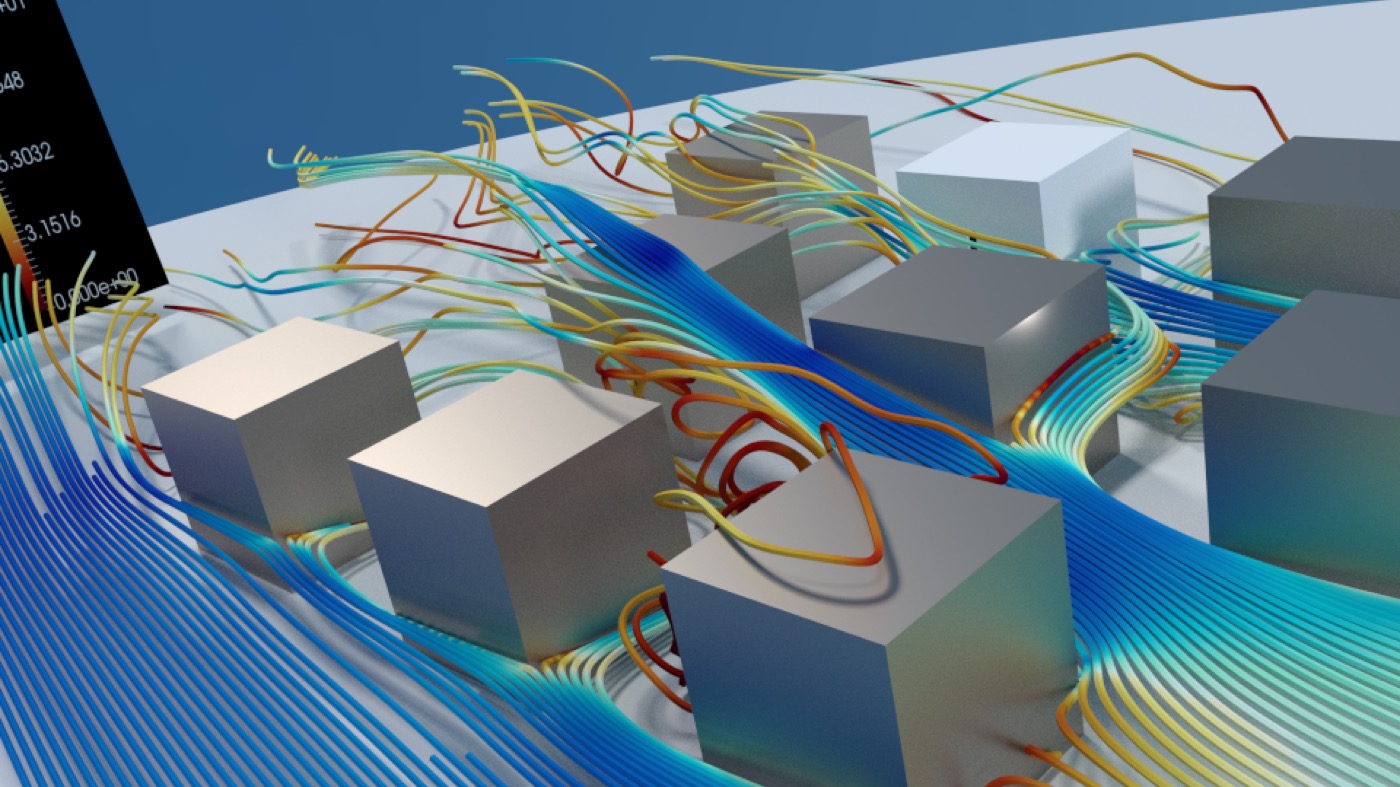
Computational fluid dynamics simulation of wind flowing around an array of cubic buildings, with streamlines coloured by velocity and vortex structures picked out
Simulated airflow around a building array: streamlines coloured by velocity magnitude, with the vortex structures that govern how pollutants and pathogens are carried between buildings.

Why this matters

Environmental and public-health systems are hard to predict because they are complex, variable and only partly observed. A hospital ward may contain a handful of sensors while air, heat, people and contaminants move through it constantly. An aquifer may be understood through a small number of boreholes. A sanitation system serving millions may be documented through incomplete records.

Detailed physical simulation can represent the underlying processes, but it may be too expensive for real-time decisions, and it drifts from reality when its assumptions or starting conditions are wrong. Machine learning finds patterns quickly, but a model trained only on data can produce physically impossible results, or fail outside the conditions it was trained on.

We use physics to constrain what data-driven models can conclude, and measurements to correct what physical models assume — and we quantify the uncertainty, so that a prediction comes with a statement of how much confidence to place in it.

What these methods enable

  • Forecast change, from contaminant movement underground to the transport of airborne infection.
  • Update simulations using live measurements, so models track occupied buildings and environmental systems.
  • Replace expensive simulations with faster surrogate models where rapid decisions are needed.
  • Test designs and interventions before physical deployment.
  • Identify the processes and parameters that matter most.
  • Quantify uncertainty, rather than presenting a single prediction as certain.
  • Optimise competing objectives: health, comfort, energy use, resilience and cost.

These capabilities support research across indoor air, water, sanitation, public health, ground engineering and the circular economy.

Our methods

Physics-informed machine learning

Physics-informed machine learning builds physical laws into the way a model learns, reducing the risk of predictions that fit the data but violate the behaviour of the real system. Xiaohui Chen, who leads the Geomodelling and Artificial Intelligence Group, develops physics-informed neural networks for unsaturated groundwater flow, ground consolidation and contaminant transport. Amirul Khan works on the numerical foundations of these methods, including how such models select the points they learn from. Mohsen Besharat applies them to hydraulics, predicting pressure, velocity and contaminant loads in transient and two-phase flows.
Bayesian inference and model calibration

Marco-Felipe King uses Bayesian inference and simulation-based methods to calibrate models against experimental and field evidence, including microbial exposure and transmission models and the assumptions behind how microorganisms transfer between hands and surfaces. Rather than one apparently certain value, calibration returns a distribution of plausible values, so uncertainty is carried through into the prediction.

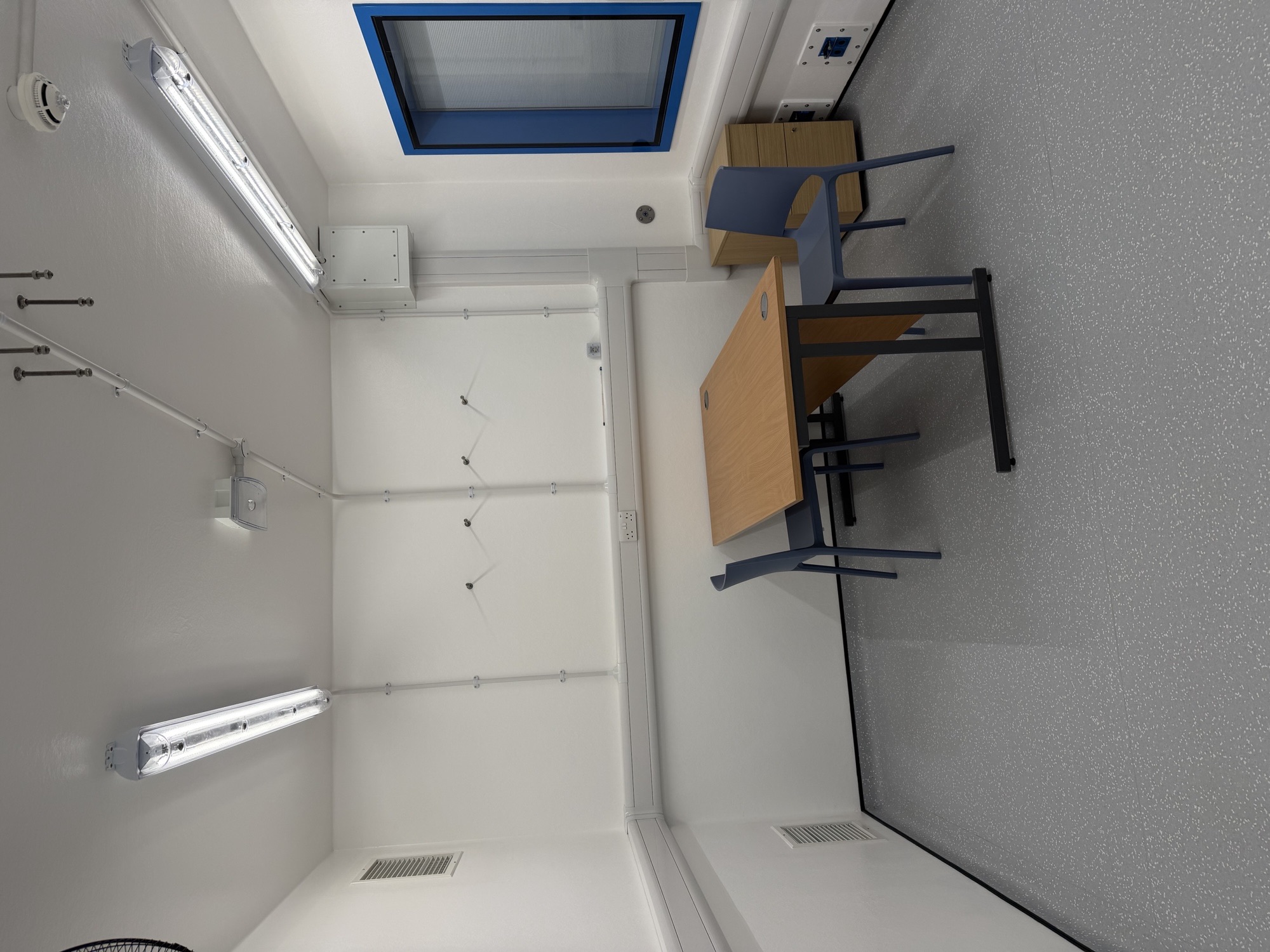
Interior of the aerobiology chamber arranged as an office, with wall-mounted airspeed sensors and controlled supply and extract
Inside the aerobiology chamber, arranged as an office. Wall-mounted airspeed sensors and controlled ventilation give the measurements that models are calibrated and updated against.

Data assimilation and real-time inference

Marco-Felipe King and Amirul Khan develop data-assimilation methods for indoor environments, combining airflow simulation with carbon dioxide and other sensor measurements. The aim is an operational digital twin: a representation of an occupied space that updates from real-world data and forecasts where air, water or contaminants are likely to move.

High-performance and real-time simulation

Amirul Khan develops massively parallel lattice-Boltzmann methods for graphics-processing units, coupling turbulence simulation with techniques that represent moving people and objects, for test chambers, hospital wards and urban environments. Marco-Felipe King develops reduced-order solvers for indoor airflow and the spread of microorganisms. Duncan Borman develops computational fluid dynamics for complex free-surface and multiphase flows in river weirs.

Hydrological, hydrodynamic and flood-risk modelling

Mark Trigg develops hydrological and hydrodynamic models of river systems, floodplains and water-related risk, from catchment and infrastructure scale to continental and global flood assessment, combining process-based modelling with remote sensing. Recent applications include rapid city-scale flood modelling after flooding in Nairobi, flood-risk management for displaced communities in Ethiopia, and river and infrastructure research in the Congo Basin and Tanzania.

Computational hydraulics and digital water networks

Mohsen Besharat combines experiments with one-dimensional and CFD models to investigate two-phase transient flows, air entrapment and protective devices such as air valves and vessels, including transient-induced compressed-air energy storage. He also develops AI-driven monitoring to forecast contamination and transient-flow conditions for operational digital twins of water networks.

Reduced-order models and surrogate simulation

A detailed simulation may take hours or days, which is impractical when thousands of designs or future conditions must be considered. Amirul Khan develops reduced-order and machine-learning approaches for indoor environments and interactive building design; Xiaohui Chen develops neural surrogate models for rapid prediction of groundwater and geoenvironmental processes.

Multi-objective optimisation

A hospital ward may need to reduce infection risk while maintaining thermal comfort and limiting energy demand. Amirul Khan applies CFD and multi-objective optimisation to indoor-environment design, including hospital ventilation and in-duct ultraviolet disinfection, so that decision-makers can compare credible options and see the compromises involved.

Multiphase and coupled-process modelling

Duncan Borman models multiphase and free-surface flows, including aerated flows over spillways and the non-Newtonian mixing that affects the energy efficiency of anaerobic digesters. Mohsen Besharat models two-phase transient flows and pressure surges in water infrastructure. Xiaohui Chen and Shashank Subramanyam develop coupled thermal, hydraulic, mechanical and chemical models for fractured and porous ground.

Statistical and chemometric inference

Environmental datasets are large, noisy and shaped by overlapping sources. Maryam Asachi applies multivariate statistical, spectroscopic and chemometric methods to identify pollution sources, estimate their contributions to water quality, and turn complex analytical measurements into information that supports monitoring and treatment decisions.

From methods to decisions

This work is not pursued in isolation. It develops alongside laboratory experiments, field measurement and engagement with the people responsible for buildings, infrastructure and environmental systems. A typical project combines measurement, physical modelling, inference, uncertainty analysis, prediction and optimisation, and then translation into evidence that designers, operators or policymakers can use.

Explore our research facilities

Computational research at Leeds

Amirul Khan directs the Centre for Computational Engineering and co-leads the computational group of the Leeds Institute for Fluid Dynamics. Duncan Borman leads the Institute's MSc group. Xiaohui Chen founded and leads the Geomodelling and Artificial Intelligence Group. These connections bring environmental engineers together with applied mathematicians, computer scientists, fluid dynamicists and data scientists.

Study with us

We supervise doctoral research in physics-informed machine learning, computational fluid dynamics, Bayesian inference and uncertainty quantification, data assimilation and digital twins, high-performance and GPU computing, reduced-order and surrogate modelling, optimisation, environmental statistics and chemometrics, and coupled environmental and ground processes. We welcome applicants from engineering, mathematics, physics, computing, data science and the environmental sciences.

Our researchers also contribute to the EPSRC Centre for Doctoral Training in Future Fluid Dynamics, which combines advanced fluid dynamics with data science and machine learning through an integrated MSc and PhD.

Meet our researchers

Work with us

We work with partners whose systems are difficult to model, only partly observed, or too computationally expensive to simulate at the speed required: making better use of sensor data, calibrating a complex model against observations, quantifying uncertainty, accelerating an existing simulation, developing predictive control or an operational digital twin, exploring a large design space, or optimising competing health, environmental, energy and cost objectives.

Discuss a research problem with us · m.f.king@leeds.ac.uk