

The Challenge
Lead Researchers: Prof. Cath Noakes OBE FREng, Dr Marco-Felipe King, Dr Louise Fletcher, and Dr Waseem Hiwar
Key Bodies Advised: UK SAGE (Environment and Modelling Group), World Health Organization (WHO), NHS England, DfE, CIBSE, REHVA
Recognition: OBE (2020), FREng, Royal Academy of Engineering President's Special Award, and 2026 Pettenkofer Award (Indoor Air 2026)
When SARS-CoV-2 emerged in early 2020, governments, health services, and building operators faced urgent questions with limited direct evidence: how far does the virus travel in indoor air, how much does surface contact matter relative to inhalation, and what practical changes to ventilation, occupancy, and air cleaning can make hospitals, schools, workplaces, and public transport safer?
The Research
For more than two decades prior to the pandemic, researchers in the WPE group, led by Prof. Cath Noakes alongside Dr Louise Fletcher and Dr Marco-Felipe King, had combined experiments in the University of Leeds's controlled walk-in aerobiology chamber with computational fluid dynamics (CFD) and quantitative microbial risk assessment (QMRA).
Their pre-pandemic and pandemic research established:
- How respiratory aerosols are generated, dispersed by room airflows, and diluted by mechanical and natural ventilation.
- How airborne pathogens interact with hospital ward design, ultraviolet germicidal irradiation (UV-C), and portable air cleaners.
- How surface-to-hand-to-mucosa (fomite) transfer operates alongside short- and long-range inhalation in clinical and public settings.
During the pandemic, the team led and contributed to major national studies including PROTECT (the UK National Core Study on transmission and environment), TRACK (transport risk assessment), AIRBODS, and Class-ACT (CO₂ monitoring and air cleaning trials in 30 Bradford primary schools).
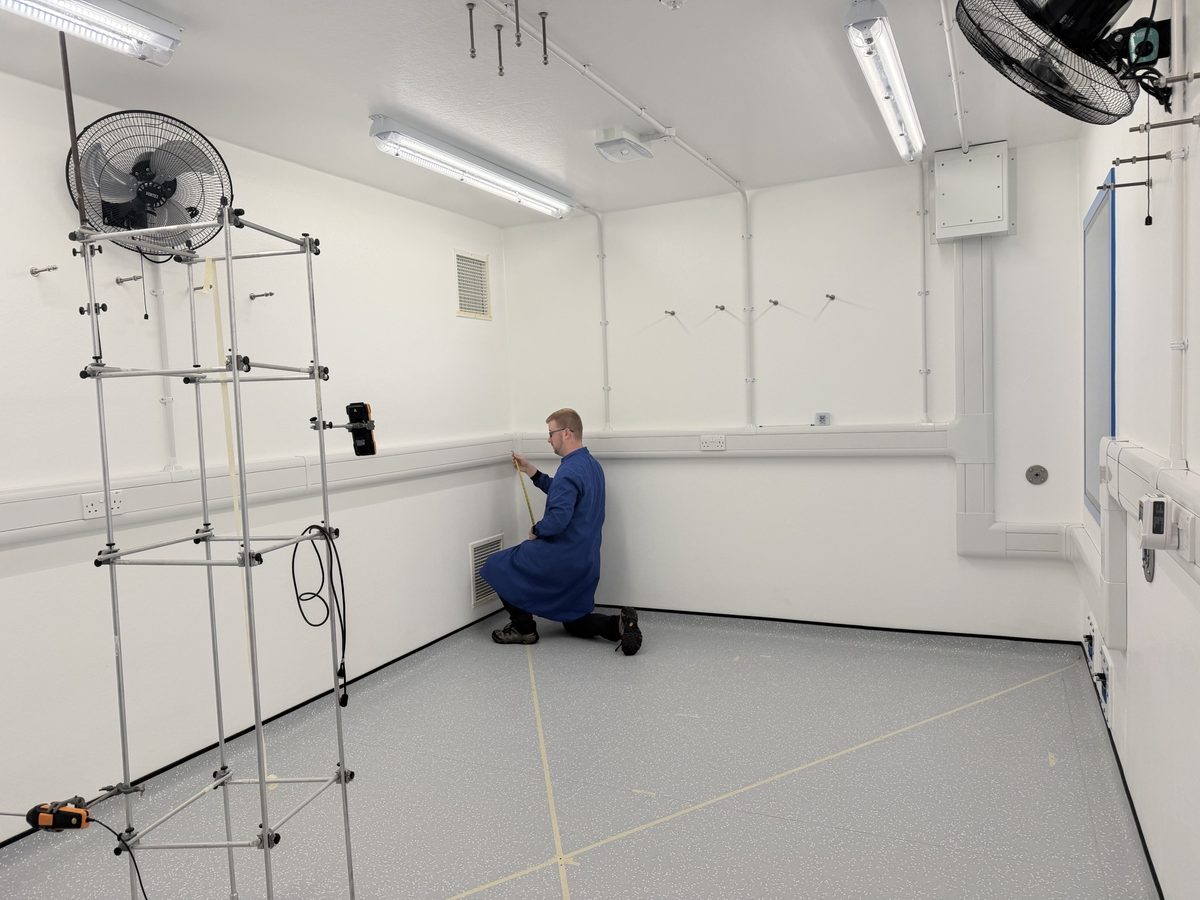
The controlled walk-in aerobiology chamber at the University of Leeds
National & International Impact
Chairing the SAGE Environment and Modelling Group (EMG)
In April 2020, Prof. Noakes was appointed to the UK Government's Scientific Advisory Group for Emergencies (SAGE) and established and chaired its Environment and Modelling Group (EMG), with Dr King contributing to EMG transmission modelling. EMG produced more than 40 evidence papers directly informing Cabinet Office, DHSC, DfE, and HSE decisions.
Elevating Ventilation in Public Health Policy
Research and advice from the Leeds team underpinned UK Government public communications ("Hands, Face, Space, and Fresh Air"), updated NHS Health Technical Memorandum (HTM 03-01) hospital ventilation guidance, and informed professional engineering guidance issued by CIBSE and REHVA.
Informing World Health Organization Guidance
Professor Noakes served as an adviser to the World Health Organization (WHO) Environment and Engineering Control Expert Advisory Panel (ECAP), contributing to the WHO Roadmap to Improve and Ensure Good Indoor Ventilation in the Context of COVID-19 (2021) and subsequent global Consensus Statements on indoor air pathogen transmission.
Safer Schools and Public Buildings
Evidence from the Leeds team informed the Department for Education's rollout of more than 350,000 CO₂ monitors and thousands of HEPA air cleaning units across UK schools and colleges, alongside the landmark Class-ACT trial across 30 Bradford primary schools.
Work With Our Indoor Air & Healthy Buildings Team
To discuss collaborative research on indoor air quality, hospital infection prevention, or aerobiology chamber testing, please contact our team.